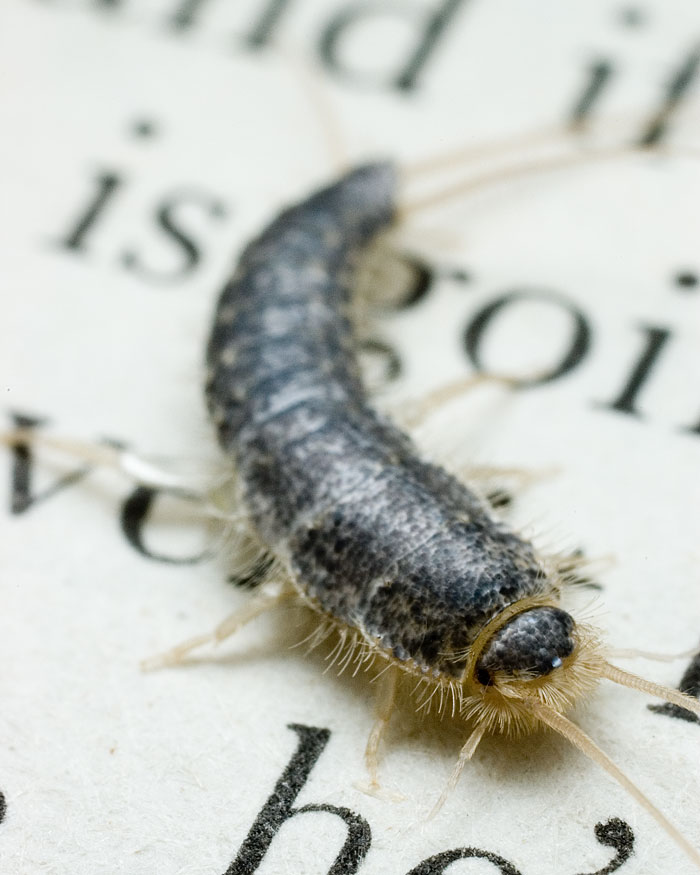
 Funnily enough, today in my house I came across two of these insects, called Silverfish (order Thysanura), in separate rooms. They quite often occur in human habitations, though I've never seen them before in mine. Was it just a coincidence that I saw my first and second on the same day, or am I witnessing the overrunning of the whole house?
These insects, together with the similar looking bristletails (Archaeognatha), are generally thought of as 'primitive' insects. Looking at the phylogeny of insects (e.g. here at tolweb.org) it's obvious that the two groups branched off quite early from the rest of the insects. Silverfish and bristletails were originally collectively called the 'Apterygota' (without wings), though this grouping is now considered artificial in the sense that the two orders diverged separately, so do not constitute a clade.
So they're thought to have characters pretty similar to whatever the ancestral insect was. And they seem to survive pretty well by sticking to their guns, dated as they are.
They can eat almost anything, and this keeps them happy places we might think are pretty nutrient poor. Take human houses, libraries, museums; silverfish happily eat book binding glue, paper, photos, fabrics (natural and synthetic)... nothing I'd enjoy munching on.
I sort invertebrate pitfall trap contents brought back from the Simpson Desert, a fairly inhospitable part of the earth. Thysanura turn up regularly in the samples; they obviously don't mind the hot, dry conditions where nutrients aren't a thing to waste.
So I won't be too worried if these things have taken a hold in my house. Hopefully they won't eat through all my books. Moreover, it's fun to see something that looks like it just crawled out of the ocean living happily in our world of processed and synthetic materials.
Further Reading:
Wikipedia: Silverfish
Wikipedia: Insect Evolution


 Posts
Posts


8 comments:
Wow! (I think I might have said that before about posts on this blog.)
They will eat your books, though. When I live up north, my books suffered badly from them and the cockroaches. The humidity came a distant third.
Yes, they do eat your books.
But hey, they're not as voracious or objectionable as rodents.
what does viagra do viagra online uk viagra paypal viagra soft tabs watermelon viagra buy viagra meds online non prescription viagra viagra price Buy Viagra Online No Prescription mexican viagra viagra sales viagra online uk viagra online no prescription too much viagra
Buying Viagra And Avoiding Online Scams : The following information from Pfizer is provided as a guide and warning to potential consumers who seek to Buy Viagra online: Avoiding pharmacy scams will help you save a lot of time and money as well as frustration. Many so called online pharmacies sell dangerous fake versions of Viagra that are not only illegal but may be harmful to your health.
Hello
Very informative post about Ancient insects! Keep the nice job. We would love to see more.
thanks and have a nice day!!
[url=http://forums.bleachexile.com/member.php?u=57438]digital ccd camera [/url] and
[url=http://forums.bleachexile.com/member.php?u=57532]knee pain
hip pain
chest pain
chronic pain
back pain
[/url]
[url=http://kinopoisk.sms-jet.ru/sitemap.html]скачать фильмы[/url] скачать фильмы
digital camera techniques and
joint pain
hip pain
back pain treatment
muscle relaxer
chest pain
hairy black lesbian 69 amatuer sex lesbian 69 lesbians teens real hot lesbians dildos free lesbian old movies india lesbian movie kora kryk lesbian
What it about?
Generic Viagra buy
Generic Viagra
Tadalis SX
Generic Viagra
Sildenafil citrate
Caverta
Kamagra
Post a Comment